
TWO:The war in Afghanistan was alluded to in the Royal Speech, at the opening of the Session of 1843, in terms of congratulation at the complete success that had attended the recent military operations in that country, owing to the high ability with which they had been directed, as well as the constancy and valour of the European and native forces, which had established, by decisive victories on the scenes of former disasters, the superiority of her Majesty's arms, and had effected the liberation of the British subjects that had been held in captivity. This, therefore, is the proper time to relate briefly the incidents of that war, some of which are full of romantic interest. About the year 1837 the attention of the British[494] Government in India was attracted by the conduct of certain supposed agents of Russia, in the countries to the west of the Indus. The Russian ambassador, Simonitch, was urging the Shah to lay siege to Herat, "the key to India," and the place was soon closely invested. It was saved by the fortuitous presence in the town of a gallant young officer of engineers, Eldred Pottinger, who rallied the inhabitants and beat off the enemy. Meanwhile, another Russian agent, Vicovitch by name, had been sent to Cabul. In order to counteract his designs, it was thought desirable to establish an alliance with the rulers of Afghanistan. With this view overtures were made to Dost Mahomed Khan through a mission headed by Alexander Burnes. These having failed, chiefly from the ill-advised interference with Burnes of the Governor-General, Lord Auckland, the British Government sought to establish a friendly power in Afghanistan by aiding the exiled prince, Shah Sujah, in another attempt to regain his throne. The step, which was condemned by numerous clear-sighted people in India, was probably forced upon Lord Auckland by the Melbourne Ministry, to whom it was recommended by the military authorities at home, among them the Duke of Wellington. The chief of Cabul had an army of 14,000 men, including 6,000 cavalry, with 40 field-pieces. His brothers held Candahar and the surrounding country, with a military force of 4,000 men and 50 guns. The British force assembled to support the claims of his opponent amounted to 28,000 men, aided by a contingent force of 6,000 Sikhs, furnished by the ruler of the Panjab, and about 5,000 troops raised by the Shah's eldest son. This combined force was called "the Army of the Indus." Under the chief command of Sir John Keane, it advanced to the town of Quetta, and thence to Candahar, which was occupied without opposition; and there, on the 8th of May, 1839, Shah Sujah was solemnly enthroned. After this the march was resumed towards Cabul. The fortress of Ghuznee, believed by the Afghans to be impregnable, was blown up and taken by storm. The invading army reached Cabul, and on the 7th of August the restored sovereign made his public entry into his capital. Having thus accomplished its mission, the Army of the Indus returned home, leaving behind a detachment of 8,000 men. For two years Shah Sujah and his allies remained in possession of Cabul and Candahar, Dost Mahomed having surrendered after having won a partial success over the British on the 2nd of November, 1840.
THREE:Hunt, and about a dozen of his friends, were seized on the platform. Bamford and some others, who had escaped, were afterwards taken. The streets were then cleared by the infantry. Such was the celebrated Manchester massacre, in which the actual wounds inflicted by the soldiers do not appear to have been many. About seventy people were carried to the infirmaries, or went there, to have their wounds dressed¡ªa considerable number for severe cuts and fractured limbs; and six lives were lost, including a special constable run over by the cavalry, and a Manchester Yeoman, who was struck from his horse by a brickbat, aimed by a man whom he was pursuing.[305]
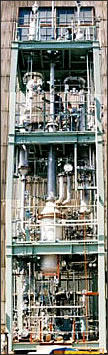
High quality is being demanded in many fields nowadays and so in order to satisfy that we developed a high-purity distillation system in collaboration with Ube industries, Ltd. and Kanto Chemical Co., Inc. The system is used to refine cleaning solutions for the semiconductor industry, medical materials, etc. of high purity (residual ion concentration: 0.01 to 1.0 ppb).
- Our High-purity distillation system provide our clients with high solvent recovery rate, almost 100%.
- The quality of the products/output from our system is very stable, which makes production management very easy, and easier than the conventional ion exchange resin method.
- No emission of waste brings our clients reduction of running cost for environmental measures.
- Our various devices minimize entrainment.
- To prevent the elution of metal, you could ask us the system made of Teflon.
- Our High-purity distillation system has been already proved for solvents that trigger very rapid decomposition reactions, such as hydrogen peroxide.
- Product guide
- Alcohol distillation
- Distillation equipment
- High-purity distillation system
- Membrane separation type solvent dehydration system
- Reactor
- Evaporative concentration equipment
- Coulter spray dryer
- Microwave treatment system
- Filter dryer
- OS filter (continuous vacuum rotating filter)
- Hydrocyclone (liquid cyclone)
- Thermal oil heater (heat medium boiler)
- Process air heater (air heater)
- Ammonia treatment system
- Catalytic deodorizing equipment for ammonia and VOC gas
- Stationary cryogenic storage tank
- Portable cryogenic container
- Cryogenic liquefied gas evaporator